SAVE 30%·Free shipping on all subscriptions
DR BARRON
★★★★★ 4.9 Customer Rating

Your OB Said “It’s Normal. It’ll Grow Back.”
Here’s What I Tell New Moms.

She is right that it grows back. Postpartum shedding is hormonal, it is common, and for most women it is temporary. But “just wait it out” is not a plan, and it is not much comfort at month four with a clump of hair in your hand and a baby you cannot take anything that might reach. After twenty years treating hormones, I built the formula I wished I could hand the new moms in my practice. Not to stop the shed. To support your body while it recovers.

Dr. Renanit Barron
Renanit E. Barron, M.D.
Board-Certified Endocrinologist
20+ years in practice · 100,000+ patient visits

As a board-certified endocrinologist, I have spent over two decades treating the systems hormones quietly run. Thyroid. Metabolism. The way a body recalibrates after a major hormonal event. And few events are more abrupt than birth.

In my practice, I have lost count of the new mothers who have described the same thing. It starts around three or four months after delivery. The hair comes out in the shower, in the brush, wrapped around the baby’s fingers. The ponytail is half the size it was. A ring of short hairs stands up along the hairline. Nobody warned them, so it does not read as a known phase. It reads as something is wrong with me, and I might be going bald.

“Dr. Barron, my hair is coming out in clumps. My OB said it’s normal and it’ll grow back. But nobody told me it would be this bad, and I’m breastfeeding, so I can’t find a straight answer on what I’m even allowed to take.” A patient, four months postpartum · a version of this I have heard hundreds of times

Here is what stays with me. She is almost always right that it is temporary. The reassurance her OB gave her is true. But she was handed nothing to do with that reassurance, no way to support her own recovery, and no honest answer to the one question on her mind: is it safe to take anything while I am nursing.

And it is rarely just about the hair. By the time she reaches me she has often been grieving quietly. Her hair was the part of her that still felt like her through everything else that changed. Watching it come out in fistfuls reads less like a cosmetic problem and more like losing herself in the middle of the hardest transition of her life. She does not recognize the woman in the mirror or the photos. More than anything, she just wants to feel like herself again, and to do it without ever risking her baby. That is the part the “it’s normal” conversation never reaches.

What I see in my practice

~50%
about half of new moms go through this shed. You are not the exception, and you are not going bald.
3 to 4 months
when it usually begins, often well after the last appointment where someone checked on you. It tends to peak around month four or five.
70%+
already take a supplement, almost always a prenatal that was built for pregnancy, not for recovering after one.

Prevalence and supplement-use figures are sourced (see references). Practice observations are Dr. Barron’s own.

The numbers are not what stay with me. What stays with me is the woman who was told not to worry, sent home with no plan, and left to wait it out alone while she was too frightened to take anything. This is a recovery you can support. It is not a verdict you have to brace through with nothing.

01The Biology Nobody Explains

Estrogen Held Your Hair. Then It Dropped.

Through pregnancy, high estrogen does something wonderful for hair. It holds follicles in their growth phase, so the hair you would normally shed stays put. That is the thick, full pregnancy mane so many women love.

After delivery, estrogen falls sharply, within days. All at once, the large cohort of follicles that estrogen had been holding in growth is released into the resting phase together. Resting hairs do not fall right away. They let go about two to four months later, in a wave. That is why month four feels like it came out of nowhere. You are not losing hair you were meant to keep. You are shedding, all at once, the hair pregnancy let you hold onto.

This has a name. Telogen effluvium. It is hormonal, it is temporary, and no supplement reverses the hormone drop that causes it. Anyone who promises to “stop” it is not being straight with you.

~3.6M
US births a year. Roughly half of those moms will feel this shed.
  • 2 to 4 months: the lag between the estrogen drop at birth and the wave of shedding. The cause came months before the symptom.
  • ~12 months: by which it has largely resolved for most women, with a ring of short new hairs along the hairline as the visible sign of recovery.
Cleveland Clinic; StatPearls (NIH). See references.

So if the shed itself is hormonal and self-resolving, what is left to do? This is the question that matters. You cannot change the hormone drop. You can support the recovery your body has already started: the structure your new hair is rebuilt from, and the nutrient environment of the follicle, at the exact moment recovery and nursing draw those reserves down.

Almost every new mom who reaches me has already tried something. A prenatal she kept taking. A drugstore biotin gummy. A collagen powder. Most of the time it did nothing she could see, and she concluded supplements do not work. I understand why. But most of those products were never built for what recovery after birth actually demands.

Why One Ingredient Was Never the Answer

For years the standard advice for thinning hair was the same. Grab a single-ingredient hair vitamin and wait. So I went back to the research on what actually moves the numbers. The lesson was not about any one ingredient. It was that a single ingredient on its own was never the answer. The evidence that holds up tested a combination.

The combination this formula is built around

+45.95%
more hair density, vs baseline
−38.89%
less hair fall, vs baseline
105
women in the double-blind RCT
90
days, double-blind

Key finding: it was the studied combination, not any single ingredient on its own, that moved these numbers. The exact pairing this formula is built around.

Individual-ingredient combination study (biotin + silica), not a finished-product result. Patel et al., Cureus, 2025 (n=105).

So how did we get here? How did a single ingredient become the headline of an entire category? The answer is in how the hair-gummy aisle was built.

How the Hair Gummy Got Stuck

Understanding why most hair gummies fail means understanding how the category grew, and where it stopped keeping up with the science.

How the hair gummy evolved

1950s–1980s · The deficiency era

One vitamin becomes "the hair vitamin"

Vitamins and minerals were identified and deficiency diseases conquered. The goal was simple: prevent deficiency. A single nutrient earned its reputation here, in people who were genuinely short on it.

1990s–2000s · The beauty-gummy boom

Label appeal beats dosing

Hair supplements became big business. Brands competed on a familiar name and a long ingredient list, using whatever amount was cheap to manufacture, not the amount the research tested.

2010s · The mechanism era

The real drivers come into focus

Research on collagen turnover, keratin synthesis, and the follicle’s nutrient environment began to explain why structure and recovery matter as much as any single vitamin. Most products kept selling biotin alone and ignored the rest.

2020s · The recovery-specific standard

Matching the formula to the moment

The science now points to specific ingredient pairings, built for the demands of recovery, and disclosed dose by dose. Most of the shelf still has not caught up.

None of this is fringe. The science moved forward. Most of the shelf did not.

So once you see that, the question becomes why a product with the right names on the label still does nothing. Three failures show up again and again.

Failure 1 · Hidden Doses

Before you can ask whether a formula is dosed well, you have to be able to see the doses at all. Most hair gummies will not let you. They roll the actives into a single “proprietary blend,” list a flattering total, and hide how much of each ingredient is actually inside. The one number that matters, how much of each thing you are getting, is the one the label leaves out.

For a new mom reading every label because she is nursing, this is not a small thing. You cannot vet what you cannot see.

Every dose, printed on the label

All 11 actives, every per-serving amount disclosed, so you can check each one against the research yourself.

Collagen Peptides350 mg
MSM50 mg
Pumpkin Seed50 mg
Bamboo Silica15 mg
L-Cysteine10 mg
Biotin10,000 mcg
Vitamin C30 mg
Vitamin D335 mcg
Vitamin E6 mg
Zinc5 mg
Selenium25 mcg

No proprietary blends. Nothing folded out of view.

Every dose printed on the label. No proprietary blend. You can see exactly what you are getting, check each ingredient against the research yourself, and take the full list to your own OB or lactation consultant. That is the opposite of how most of this aisle is built.

Why does this matter so much for you, specifically? Because a recovering postpartum follicle is not asking for a longer ingredient list. It is asking for the right things, in the right pairings, at the moment recovery and nursing have pushed its demands up. A label-deep gummy was built for a front-of-bottle, not for what your body is doing right now.

What a Supplement Can, and Cannot, Do Here

Postpartum shedding is one event with one cause, and being honest about it is the whole point.

What it cannot do
The shed itself is the hormone drop after birth

No supplement reverses that, and it is temporary. The hair will come back on its own timeline. Anyone selling you a gummy that “stops postpartum hair loss” is selling you something there is no biology to deliver.

What it can support
The recovery your body has already started

New hair is rebuilt from collagen and keratin, and the follicle runs on a nutrient environment that recovery and breastfeeding draw down hard. That is what a formula can honestly support: the raw materials and the environment, while your body does the part only time can do.

A generic hair gummy works on the surface, the strand you can see. Recovery starts deeper, in the structure the new strand is built from. Supporting one without the other changes little.

The DR BARRON approach

Built for recovery, not a promise to stop the shed. Hydrolyzed collagen with vitamin C for the scaffold, the keratin building blocks for the new strand, and zinc and selenium for the follicle environment pregnancy and nursing deplete first.

Here is what that difference looks like in practice. Two moms, same shedding, two different formulas.

Two moms, two formulas

Same shedding, the same months of taking it faithfully. The difference is what each formula was built to do.

✕  A generic hair gummy

1

A single vitamin and minerals, nothing built for recovery

2

Doses hidden inside a proprietary blend

3

No way to vet it against your nursing questions

“I took it faithfully and couldn’t even tell what was in it.”

✓  DR BARRON

1

Eleven actives chosen to support postpartum recovery

2

Built around the silica + biotin pairing

3

Collagen and vitamin C, studied for density

4

Every dose on the label, to take to your provider

Support aimed at recovery, not a promise to stop the shed.

Failure 2 · The Wrong Target

By the time most new moms come to me, they have already tried this the hard way. It usually sounds like this: “I took my prenatal the whole time, I added biotin, and I’m still shedding.” Of course she is. A prenatal is built to support growing a baby. It was never designed for what the body needs while it recovers from one. And a single-ingredient hair vitamin supports general structure at best. Neither was built around the demands recovery and nursing place on collagen synthesis, keratin building blocks, and the follicle’s nutrient reserves all at once.

It is not that she did anything wrong. She did everything right. The products were just built for a different job.

Why Your Prenatal Falls Short

A prenatal is built for one job, growing a baby, and it is good at that job. It is not built for the hormonal cliff after delivery, or for the way recovery and breastfeeding draw down the cofactors hair depends on. Three gaps explain why.

The three gaps

Built for pregnancy, not recovery

Made to support a growing baby, not a body shedding a synchronized wave of hair after the estrogen drop.

One ingredient touches the strand

Nothing built for collagen structure, the keratin building blocks, or the antioxidant load recovery raises.

Hidden in a blend

Many hair gummies hide the amounts in one proprietary blend, so you cannot see how little of each is inside, or take a real list to your provider.

The DR BARRON Gold Standard

If that is how most of the aisle is built, here is what is actually on our label, next to a leading hair gummy. More of the proven actives, plus the ones they skip entirely.

More of the actives that matter

DR BARRON Leading hair gummy
Zinc + SeleniumDR BARRON
On label
Often skipped
Collagen peptidesDR BARRON
350 mg
Rarely included
Vitamin C+25%
30 mg
24 mg
Bamboo silicaDR BARRON
15 mg
Not included
Biotin+250%
10,000 mcg
2,800 mcg

Five of the eleven actives, the ones most relevant to recovery, structure, and the follicle environment. All eleven, every dose, are printed in full on the label. Completeness comparison of label amounts, not a claim that more of any single nutrient grows more hair.

So this is the route the support actually travels, and recovery raises the demand at every step.

How the support travels

1
Intake

One daily dose

Eleven actives in one dose, paired the way the research pairs them. One gummy, not a stack you have to manage with a newborn.

2
Into the bloodstream

Absorbed and carried

Demand for these cofactors climbs while recovery and nursing draw the reserves down.

3
The follicle

Where the new hair is built

Where structure is rebuilt and the next growth phase is supported as the shed resolves.

↓   Where it goes to work · the pathways recovery runs on

The four pathways

Pathway 01 · Structure
The collagen scaffold

New hair is rebuilt on a collagen scaffold, and recovery raises the demand to rebuild it.

Collagen peptidesVitamin CBamboo silica
Pathway 02 · The strand
Keratin’s raw materials

Keratin is about 95% of the strand. Its building blocks and sulfur bonds depend on cofactors recovery stretches thin.

BiotinL-cysteineMSMZinc
Pathway 03 · The follicle environment
Antioxidant defense

The antioxidant reserve that shields follicle cells runs lower during recovery. Replenishing it supports the follicle’s environment.

Vitamin CVitamin D3Vitamin ESeleniumZinc
Pathway 04 · Replenishment
What recovery draws down

Recovery and breastfeeding are metabolically demanding. The same cofactors hair depends on are the ones being pulled in many directions at once.

ZincSeleniumVitamin D3

There is a second, quieter version of the same mistake. Recovery depletes more than one thing at once, so single nutrients taken one at a time were never the answer. The ones that matter work in pairs. These are the pairings that do the real work together, and the ones a label-deep gummy routinely splits apart.

Pairs that work together

Collagen + Vitamin C: vitamin C is the cofactor that lets your body assemble collagen. One without the other is half the job.

Bamboo silica + Biotin: together they support the keratin structure of the strand. The pairing the formula is built around.

Zinc + Selenium: the follicle’s nutrient environment runs on both, and both are drawn down during recovery and nursing.

MSM + L-cysteine: sulfur and the cysteine amino acid build the bonds that give a strand its strength.

Follow the money

There is a reason the shelf looks the way it does. The easiest way to win a large, fast-growing market is on label appeal, a familiar name and a long ingredient list, rather than on honest dosing and full transparency, which cost more and are harder to market. Most brands compete on the front of the bottle. We built for what is on the back of it.

$830M+
spent on hair supplements every year, most of it won on label appeal
11
actives on our label, every dose printed in full
0
proprietary blends, nothing folded out of view

Why DR BARRON is different: it is formulated by an actual medical doctor, not just endorsed by one. Dr. Renanit Barron, a board-certified endocrinologist, built the formula around the published research, put every dose on the label, and left out the proprietary blend. The standard reads high, so the label reads short.

Failure 3 · The Routine Collapses

The other route new moms take is to assemble it themselves. A collagen powder. A separate hair vitamin. The prenatal. An antioxidant. Maybe something a forum mentioned. Six bottles, six schedules, in the middle of newborn life on no sleep. It works on paper. In real life, with a baby on your hip, the routine quietly falls apart. And the moment it does, the support stops.

“I have watched this pattern for twenty years. A motivated patient leaves with a bag full of bottles, and six weeks later she has quietly stopped, because the routine was too much to keep up with. With a newborn it is even faster. The best protocol is not the most complicated one. It is the one you will actually still be taking in month three.” Dr. Renanit Barron, M.D. · Board-Certified Endocrinologist

Why routines fall apart

Week 1
Week 4
Week 8
Week 12
Multi-bottle stack One daily routine

Illustrative pattern from medication-adherence research. Not a measured product result.

Hair runs on a roughly 90-day cycle. A supplement abandoned by week eight never gets the chance to matter. The best formula is the one you will actually still be taking in month three. That sounds obvious. It is also the reason most stacks fail.

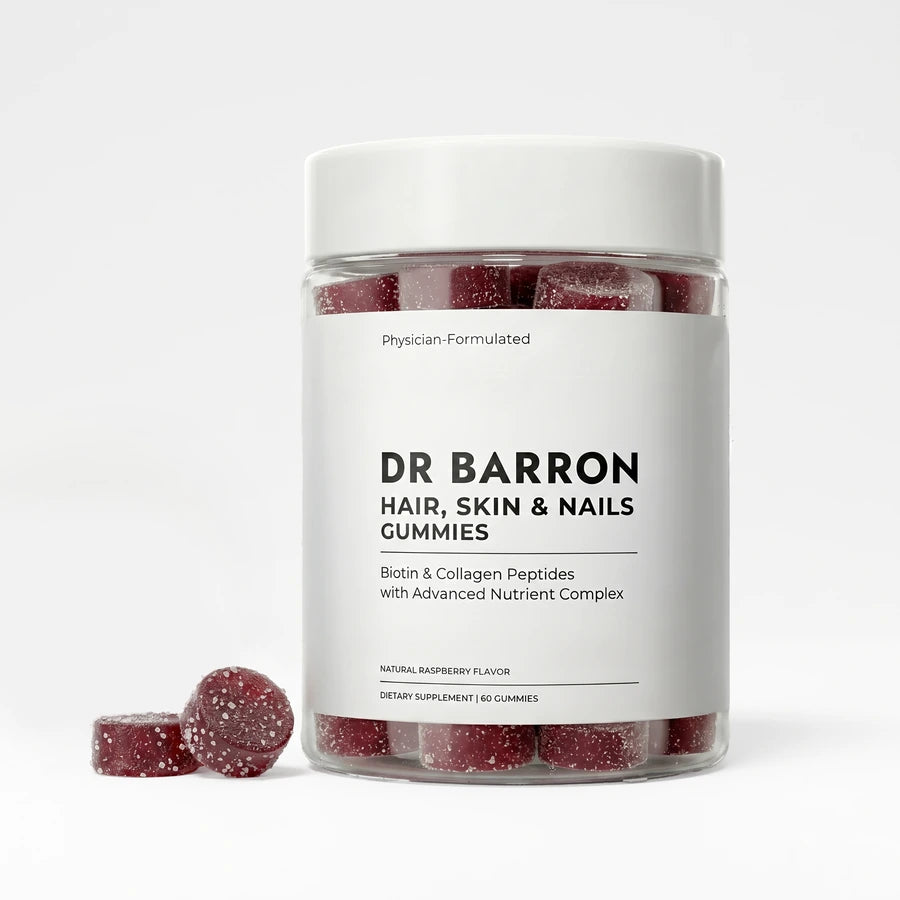
DR BARRON Hair, Skin & Nails Gummies
Tired of supplements that were never built for recovery?
Hair, Skin & Nails Gummies. Eleven actives, one daily dose, formulated to support postpartum recovery.
See the Formula
From $37/mo · 90-day guarantee
02The Right Question To Ask

The Right Question to Ask

What vitamin should I take for my hair?
What does a recovering follicle actually need right now?

Most new moms come to this asking which supplement to buy. As a physician, I ask a different question, the one I would ask about any plan: what specifically changed, and what does the body now need to support its recovery. After birth, estrogen drops and a wave of hair sheds. What recovery needs is the structure to rebuild and the nutrient environment to do it in. That single reframe is the whole formula.

“Every new mom I see gets told the same thing. It’s normal, it’ll grow back. And it usually does. The problem is that ‘just wait it out’ gives her nothing to do, and no honest answer about what she can take while she’s nursing. The shed is hormonal. Recovery has real demands. Most supplements never adapt to that. This one was built to support it.” Dr. Renanit Barron, M.D. · Board-Certified Endocrinologist · Co-Founder, DR BARRON
03Why I Built This Formula

Why I Built This Formula

If you have already taken your prenatal faithfully, added biotin, and watched the shedding keep going, your skepticism is earned. I would be skeptical too. So let me be straight about what this is and is not.

It is not a cure, and it will not stop the shed, because nothing taken by mouth stops the hormone drop after birth. The shed is temporary, and your hair comes back on its own timeline. What this is: a formula built around the pairings the research actually tested, with every dose printed on the label, to support the recovery your body is already doing, that you can cancel anytime and return within 90 days if nothing shifts.

And one thing I will not do is tell you it is “breastfeeding-safe.” Every hair brand says that. I won’t, because no gummy has been studied for that the way a claim like that should be. Instead I will show you every ingredient and every dose, so you and your own OB or lactation consultant can decide together. Talk to your provider before starting any supplement while breastfeeding. The honesty is the point. It is also why you can trust the rest of what I tell you.

For years I sent new moms away with a shrug, because there was nothing on the market built for the recovery I was watching. Eventually my co-founder and I built it, with the same discipline I apply to any plan. Review the literature. Choose only what the evidence supports. Anchor the formula on the pairing the research is built around, and include the rest at doses chosen to support the recovery pathways. Leave out anything that looked good on a label but could not earn its place.

What Makes DR BARRON Different

What makes it different

Physician-formulated. Built by a board-certified endocrinologist, not a marketing team.

Every dose on the label. No proprietary blend, nothing hidden, a real list to take to your provider.

Research-backed ingredients. Chosen for recovery and structure, not shelf appeal.

Honest about the shed. Support for your recovery, not a promise to stop something that is temporary.

One daily dose. Built for newborn life, not an eight-bottle stack.

The result is eleven actives, each chosen to support one part of recovery where it can actually be supported. Here is everything the formula is built to do, in one place.

1
The collagen scaffold

Hydrolyzed collagen with vitamin C, the cofactor that lets the body cross-link it.

2
Keratin building blocks

L-cysteine supplies the amino acid the hair shaft is built from.

3
Sulfur cross-links

MSM provides bioavailable sulfur for the bonds that give hair its strength.

4
The pairing it’s built around

Bamboo silica with biotin, the combination a 105-person trial tested together.

5
Follicle-cycle cofactors

Zinc supports keratin synthesis and normal follicle cycling.

6
The antioxidant layer

Vitamins C, D3, E and selenium support the follicle environment recovery draws down.

7
Skin and nails too

The same collagen and silica that support hair support skin elasticity and nail strength, both of which take a hit postpartum.

That is the formula in full. Eleven actives, one daily dose, built around the pairing the research tested together. Built for recovery, not the label.

DR BARRON Hair, Skin & Nails Gummies
Built for recovery, not a promise.
Hair, Skin & Nails Gummies. Endocrinologist-formulated, built around the pairing the research tested together.
See the Formula
From $37/mo · 90-day guarantee
04How It Compares

How It Compares

When a new mom asks how this compares to what she is already taking, I walk her through the same checklist I would use for any plan.

How it compares

Drugstore
Hair gummy
Generic
Prenatal
BEST CHOICE
DR BARRON Hair, Skin & Nails Gummies
DR BARRON
No proprietary blends
✕ No
Varies
✓ Yes
Built for postpartum recovery
✕ No
✕ No
✓ Yes
Every dose on the label to vet with your provider
✕ No
Varies
✓ Yes
Collagen + vitamin C pairing
✕ No
✕ No
✓ Yes
Physician-formulated
✕ No
Varies
✓ Yes
Third-party tested
Partial
Varies
✓ Yes
One daily dose
✓ Yes
✓ Yes
✓ Yes

The single daily dose is the only box a drugstore gummy reliably checks. Everything that decides whether a formula can actually support recovery, and whether you can vet it for yourself, it misses.

DR BARRON Hair, Skin & Nails Gummies

Eleven actives, one daily dose, built to support postpartum recovery.

Try DR BARRON Risk-Free TodayFrom $37/mo · 90-day guarantee

But you shouldn’t take the formula on my word alone. So here, in my own words, is why I built it to support recovery after birth, and why I refuse to tell you it is “breastfeeding-safe.”

Dr. Barron explains why she built this formula for postpartum recovery and where generic supplements and prenatals fall short.

Why You Can Trust It
Endocrinologist-FormulatedThird-Party Tested75+ Published Studies
05What New Moms Are Telling Me

What New Moms Are Telling Me

★★★★★ Verified

Clumps in the shower at four months and my OB just said it’s normal. This is the first thing that actually felt built for recovery, not a random biotin gummy.

M
Megan T.
★★★★★ Verified

Every ingredient and dose is right on the label, so I could take the list to my lactation consultant and we went through it together. That mattered to me more than any claim.

P
Priya K.
★★★★★ Verified

I never stick with supplements, and there is no way I’m managing six bottles with a newborn. One a day I can actually do.

S
Sam D.

Individual experiences. Responses to any supplement vary from person to person. Talk to your provider before starting a supplement while breastfeeding.

Why These Markers Matter

Feelings about hair are subjective. The measures the research uses are not. Density, shedding count, and growth rate are the objective markers a trichoscope can track, the same ones these studies measured. When I judge whether an ingredient has support behind it, those are the numbers I want, not a vibe in the mirror.

What The Published Research Measured

Here is the science the formula is built on, what published research found on the key ingredients, studied on their own.

What the research measured

Collagen + vitamin C · hair density+27.6%
vs placebo · 12-wk
Bamboo silica + biotin · growth rate+0.57 mm/day
vs placebo · 90-day
Collagen · skin elasticitySupports
supports skin elasticity, which also takes a hit postpartum · ingredient research

Source: Reilly 2024, Patel 2025. Per-ingredient research, not the finished gummy; bars illustrative. Not FDA-evaluated.

What to Expect, Cycle by Cycle

Hair grows on a roughly 90-day cycle, so an honest answer is measured in months, not weeks. Here is what is actually happening underneath while you take it.

What to expect, cycle by cycle

Weeks 1–4

Nothing visible yet

The follicle is being supported below the surface. The shedding you see now was set in motion months ago by the hormone drop.

Weeks 4–8

The wave passes

Much of the shedding you notice is hair that was already on its way out. Consistency matters most here, and the shed is still resolving on its own.

Month 3

A full hair cycle

The growth supported from your first weeks is what reaches the surface around now. The regrowth halo along the hairline is the visible sign your hair is coming back.

Ongoing

Daily support, not a fix

Recovery has its own timeline. This is daily support across it, not a 30-day fix, and not a substitute for time.

This is biology, not a promise. Everyone’s timeline is different. If your shedding is sudden or patchy, or has not eased by about twelve months, see a clinician, because postpartum shedding can occasionally mask thyroid or other issues.

DR BARRON Hair, Skin & Nails Gummies
One daily dose, built for recovery.
Eleven actives, every dose on the label, built around the pairing the research tested together. No proprietary blend, no stack to manage.
See the Formula
From $37/mo · 90-day guarantee
06Questions New Moms Ask Me

Questions New Moms Ask Me

The follicle cycle takes about 90 days, so any honest answer is measured in months, not weeks. Brands that promise four-week results are promising something there is nothing biological to measure. Plan in months, which is exactly why the quarterly plan and the 90-day money-back guarantee are built around one full follicle cycle. If nothing has shifted by the end of it, you get your money back.

I will be straight with you, because this is the most important question you are asking. I will not tell you it is “breastfeeding-safe.” Every hair brand says that, and no hair gummy has been studied the way a claim like that should be. What I will do is show you every ingredient and every dose, printed in full on the label, so you and your own OB or lactation consultant can review the exact list and decide together. Talk to your provider before starting any supplement while breastfeeding. That transparency is the honest version of what other brands turn into a marketing claim.

No, and I would not trust anyone who told you it would. The shed is the hormone drop after birth, it is temporary, and nothing taken by mouth reverses it. What this formula does is support the recovery your body is already working on: the collagen and keratin your new hair is rebuilt from, and the follicle’s nutrient environment, while time does the part only time can do.

Worth taking seriously. Postpartum shedding can occasionally mask thyroid dysfunction, iron-deficiency anemia, or postpartum depression, and the symptoms overlap. If your shedding is sudden, patchy, or paired with fatigue or other symptoms that do not fit, see your doctor for labs. This formula supports the structural and nutritional side of recovery. It is not a treatment for thyroid disease or anemia, and I would never present it as one. It does not contain iron, so it is not a substitute for iron your doctor may recommend.

I hear this constantly, and it is usually a mechanism problem, not proof that supplements are useless. A prenatal or a single biotin gummy was never built for what recovery after birth demands across collagen structure, the keratin building blocks, and the follicle environment at once. Our formula contains biotin, paired with bamboo silica the way the research tested it, plus collagen with vitamin C and the cofactors recovery draws down. The 90-day guarantee gives you one full follicle cycle to find out if the difference is real for you.

The quarterly plan ships every 90 days, saves the most per day, and is backed by a 90-day money-back guarantee. The monthly plan ships every 30 days with a 30-day guarantee. Pause, skip, or cancel anytime from your account, with no fees. For a refund, contact the team. No return is required on opened bottles.

07My Recommendation

Who It's For

I will not oversell this, because I do not trust anyone who talks about postpartum hair in absolutes. It is a disciplined, daily layer of support for a recovery that takes months. It works best for the mom who understands that consistency, not speed, is what the follicle responds to, and that the shed resolves on its own time.

Who it's for

  • The shed hit around month three or four and you were told only “it’s normal”
  • You want to support your recovery, not just wait it out with nothing
  • You are tired of juggling a prenatal and a shelf of separate supplements
  • You want every dose on the label so you can vet it with your OB or lactation consultant
  • Ready to give it one full follicle cycle

Who it's not for

  • Expecting visible results in a week or two
  • Sudden or patchy shedding (see a doctor first)
  • Unwilling to take it daily for three months
  • Looking for something that “stops” the shed or a prescription cure

If you recognized yourself in the first column, this is the formula I built for you. Start the 90 days. Give the follicle one full cycle to answer. The guarantee is there so the only thing you risk is finding out. And whatever you decide, take the label to your provider first if you are nursing. I would tell my own patients the same.

DR BARRON Hair, Skin & Nails Gummies

You Don’t Have to Just Wait It Out

You are not chasing a transformation, and you should not have to choose between your hair and your baby. You want to support your recovery, honestly, while your body does the rest. Eleven actives, every dose on the label, built for postpartum recovery, with a real list you can take to your provider.

Shop The Formula
$55/mo From $37/mo · about $1.24 a day · 90-day guarantee
Endocrinologist-Formulated Free Shipping on Subscriptions

References

  1. Cleveland Clinic. Postpartum hair loss (telogen effluvium): onset and resolution. Estrogen falls after delivery, synchronizing follicles into the resting phase that sheds roughly 2 to 4 months later, largely resolving within about a year.
  2. StatPearls (NIH). Telogen Effluvium. Postpartum telogen effluvium prevalence and self-limiting course.
  3. CDC / NCHS. Births: Provisional Data. ~3.6M US births per year.
  4. Reilly et al. (2024). Randomized, double-blind, placebo-controlled trial of a hydrolysed collagen and vitamin C supplement: 27.6% increase in hairs per unit area versus placebo at 12 weeks. Dermatology Research and Practice.
  5. Patel et al. (2025). Double-blind RCT (n=105) of Bambusa arundinacea silica plus Sesbania grandiflora biotin: statistically significant reduction in hair fall and increased hair growth rate (~0.57 mm/day, silica + biotin arm) over 90 days. Cureus 17(7):e89118.
  6. Methylsulfonylmethane (MSM) dose-response studies on hair and skin parameters (16-week and 120-day supplementation).
  7. Vitamin D3 and telogen effluvium; vitamin D receptor expression in hair follicles (PMC5007917).
  8. Mubki et al. / JCAD review: in a 200-patient evaluation, isolated telogen effluvium was uncommon (about 9.5%); the majority co-occurred with other patterns, supporting the recommendation to see a clinician if shedding persists or is atypical.
  9. NIH Office of Dietary Supplements. Roughly 70% of postpartum women take a dietary supplement.

This article is for informational purposes only and does not constitute medical advice. Talk to your doctor, OB, or lactation consultant before starting any supplement while breastfeeding.

These statements have not been evaluated by the Food and Drug Administration. This product is not intended to diagnose, treat, cure, or prevent any disease.

DR BARRON Hair, Skin & Nails Gummies
Hair, Skin & Nails Gummies
Built for postpartum recovery · 90-day guarantee
Get Started · Save 30%